|
 |
The inverse of a function is the set of ordered pairs obtained by interchanging the first and second elements of each pair in the original function. (This inverse may, or may not, by itself be a "function",) |
|
If the inverse of a function f (x) is also a "function",
the inverse is denoted by the notation f -1(x) and is called an "inverse function".
Note: 
A function and its inverse function can be described as the "DO" and the "UNDO" functions.
A function takes a starting value, x, performs some operation on this value, and creates an output, the y-value. The inverse function takes the output value, y, performs some operation on it, and arrives back at the original function's starting value, x.
If a function is such that its inverse is also a function,
the function is know as an invertible function. |
If the graph of a function contains a point (a, b),
then the graph of the inverse
of this function contains the point (b, a).
f (x)
x |
y=f (x) |
-2 |
-1 |
0 |
2 |
1 |
4 |
3 |
8 |
|
Consider function f (x) at the left.
Function f receives the value x as input and produces value y as output.
The inverse of function f will receive
those y-values as input and produce
those x-values as output, thus
swapping the x and y coordinates |
Inverse of f (x)
x |
inverse |
-1 |
-2 |
2 |
0 |
4 |
1 |
8 |
3 |
|
The inverse of a function may not always be a function!
 Note: The original function must be a one-to-one function Note: The original function must be a one-to-one function
to guarantee that its inverse will also be a function.
|
 |
|
(DO NOT use f -1(x), to denote an inverse that is NOT a function. i.e. an inverse "relation". Use y-1 if appropriate.)
For function f (x), as defined below, the inverse of f (x) will also be a function.
f (x) = {(2,3), (4,5), (-2,6), (1,-5)} (function)
The inverse of f (x) = {(3,2), (5,4), (6,-2), (-5,1)} (also a function)
But. let's look at another example: g (x) = {(4,1), (8,3), (-5,3), (0,1)} (function)
The inverse of g (x) = {(1,4), (3,8), (3,-5), (1,0)} (NOT a function, x's repeat)
Function f (x) is a one-to-one function and its inverse is a function.
Function g(x) is NOT a one-to-one function, and its inverse is NOT a function.
The fact that an inverse may NOT be a function, leads to some subtle differences in terminologies:
Definition: Inverse of a Function: Refers to the relation formed when the independent variable (x) is exchanged with the dependent variable (y) in a given relation. (This inverse may NOT be a function.)
Definition: Inverse Function: Occurs when the inverse of a function (defined above) is itself also a function, it is then called an inverse function. |

Composition of Functions:
A function "composed" with its inverse function yields the original starting value.
Think of them as "undoing" one another and leaving you right back where you started.
If function f and g are inverse functions, f (g(x)) = g(f (x)) = x.
Also, 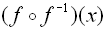 = x = x |
Graph of an Inverse Function:
The graph of an inverse relation is the reflection of the original graph
over the line y = x (called the Identity Function).
It may be necessary to restrict the domain on certain functions to
guarantee that the inverse relation is also a function.
|
Given function is y = 2x + 1.
If this starting function is reflected over the identity line, y = x, the result is the red dotted line. This new dotted red line is the inverse of y = 2x + 1.
In this example, the inverse is a function, since the inverse graph passes the vertical line test, making the inverse a function
Not all graphs produce an inverse which will also be a function.
|
|
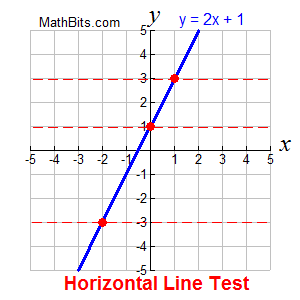
When we studied one-to-one functions, we were introduced to the horizontal line test
to determine that a function was one-to-one. Now, that a function's status of one-to-one guarantees
that an inverse of the function is also a function, we will be using the horizontal line test again.
 1-1 function
 |
Horizontal line test determines a one-to-one function:
Any horizontal line intersects the graph of a "one-to-one function" in only ONE point. |
|
This test will also now show whether the inverse of a function is also a function.
The status of an inverse of a function can be determined without graphing the inverse, if the horizontal line test
is used.
If any horizontal line intersects the original function in
only one location, the function will be a one-to-one function
and its inverse will also be a function.
The function y = 2x + 1, shown at the right, is a one-to-one function and its inverse will also be a function.
(If needed, the vertical line test can be used to show
that the given relation y = 2x + 1 is a function.) |
|
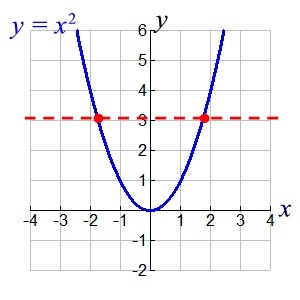
If a graphed function fails the horizontal line test,
the inverse of that function will NOT be a function.
The inverse of this function will be a "relation",
but not a "function".
It may be possible, in certain situations, to
restrict the domain to create a portion
of the graph to be a function with an
inverse that is also a function.
See more graphical information at
Finding Inverse Functions. |
|
Learn more about Inverse Functions at Finding Inverse Functions.
|
For calculator help with
inverse of
functions
Click here. |
|
|
|
For calculator help with
inverse of functions
click here. |
|
|

NOTE: The re-posting of materials (in part or whole) from this site to the Internet
is copyright violation
and is not considered "fair use" for educators. Please read the "Terms of Use". |
|