|
The lesson on Inverse Functions discussed the nature of inverse relations
and what was needed to determine if an inverse relation was actually a function by itself.
This lesson will focus on a variety of ways to "find" inverse functions in various situations.

F I N D I N G an I N V E R S E
We will look at three ways to find an inverse function:
(1) examining ordered pairs, (2) algebraically, and (3) graphically.
(1) Finding Inverses by Examining Ordered Pairs:
If the function is stated as ordered pairs, in a set or table, we can find the inverse of the function by simply swapping the ordered pairs. This is a viable option as long as the size of the set or table is of limited length.
If the function is fairly simple, we may be able to also find an algebraic inverse for the function by examining the inverse ordered pairs for a relationship or pattern.
f (x)
x |
y=f (x) |
1 |
2 |
3 |
4 |
-2 |
-1 |
0 |
1 |
|
Inverse of f (x)
x |
inverse |
2 |
1 |
4 |
3 |
-1 |
-2 |
1 |
0 |
|
The pattern in this example shows that the inverse can be expressed by subtracting one from each of its input values.
Inverse of f (x) = x - 1,
or

|
(2) Finding Inverses Algebraically:
The process of finding an inverse algebraically is also a swapping of the x and y coordinates, along with some algebraic finesse to simplify the equation. This newly formed inverse will be a relation, but it may, or may not. be a "function".
Solve algebraically:
Solving for an inverse relation algebraically is a three step process:
|
|
1. Set the function = y
2. Swap the x and y variables
3. Solve for y |
|
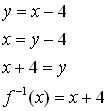
Example 1:
Find the inverse of the function 
Answer:
|
Remember:
Set = y.
Swap the variables.
Solve for y.
You can use the inverse function notation since the straight line f (x) is a one-to-one function (passing the vertical and horizontal line tests), which guarantees that f -1 will also be a function. |
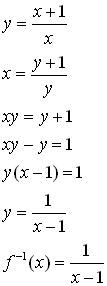
Example 2:
Find the inverse of the function  (given that x is not equal to 0). (given that x is not equal to 0).
Answer:
|
Remember:
Set = y.
Swap the variables.
Eliminate the fraction by multiplying each side by y.
Get the y's on one side of the equal sign by subtracting y from each side.
Isolate the y by factoring out the y.
Solve for y.
How do we know if f -1(x) is a function? Is f (x) a one-to-one function?
Let's prove it algebraically:
We will assume that two x-values, (a and b), have the same y-values and see what happens. In order to have a one-to-one function, we must show that a = b.
Assume: f (a) = f (b)

Yes, f (x) is a one-to-one function, and we can use function notation for the inverse. |
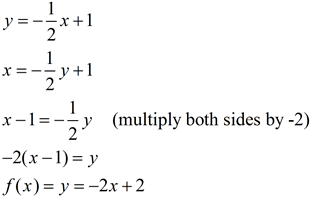
Example 3:
Given f -1(x) = -½ x + 1, express the equation of f (x).
Answer:
At first glance, this question may look like a completely different type of problem, but it is not. Apply the same strategy that was used in Example 1.
(f (x) is actually the inverse of f-1(x).)
|
For ease of writing, we refer to f (x) as y.
We are in essence, finding the inverse of the inverse to find the original function.
Since this example used function notation to state the inverse, we can assume that the coordinating function is a one-to-one function (and we are working with a straight line). So we do not need to worry about the proper use of functional notation in this problem. |
 1-1 function
 |
Horizontal line test determines a one-to-one function:
Any horizontal line intersects the graph of a "one-to-one function" in only ONE point. |
|
(3) Finding Inverses Graphically:
Example 1:
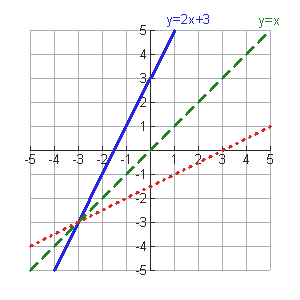
Graph the inverse of y = 2x + 3.
Consider the straight line, y = 2x + 3, as the original function. It is drawn in blue.
If reflected over the identity line, y = x, the original function becomes the red dotted graph. The new red graph is also a straight line and passes the vertical line test for functions. The inverse relation of y = 2x + 3 is also a function.
Not all graphs produce an inverse relation which is also a function. |
 |
Example 2:
 You can see that the inverse relation exists, but it is NOT a function. You can see that the inverse relation exists, but it is NOT a function. |
Sketch the graph of the inverse of y = x2. State whether the inverse is a function.
First, we get the inverse by reflecting the given function over the identity line y = x.
Then we look at the inverse to see if it is a function (does it pass the vertical line test for functions?), or is it simply a relation.
The example at the left shows the original function,
y = x2 , in blue. Its reflection over the identity line
y = x is shown in red is its inverse relation. The red dashed line will not pass the vertical line test for functions,
thus y = x2 does not have an inverse function - it has an inverse relation..
|
|
For calculator help with
inverse of
functions
Click here. |
|
|
|
For calculator help with
inverse of functions
click here. |
|
|

NOTE: The re-posting of materials (in part or whole) from this site to the Internet
is copyright violation
and is not considered "fair use" for educators. Please read the "Terms of Use". |
|