|
We know that a function is a set of ordered pairs such that given any x value,
there is only one y value that can be paired with that x value.
The following Venn diagrams depict functions:
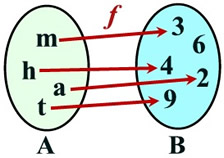 Function f:
(m,3), (a,2), (t,9), (h,4)
|
 Function g:
(m,3), (a,4), (t,9), (h,4) |
In these diagrams, set A is the domain of the function, and
the elements from set B that are used is the range of the function.
With the definition of a function in mind, let's take a look at some special "types" of functions.
 One to One One to One |
A function f from A to B is called one-to-one (or 1-1, or 1:1)
if whenever f (a) = f (b) then a = b.
And conversely, if a ≠ b,
then f (a) ≠ f (b).
No element of B is the image of more than one element in A.
|
|
Such a function is also referred to as an injective function.
A one-to-one function is a function where every unique input maps to a strictly unique output.
In a one-to-one function, given any y value, there is only one x paired with that y value.
You can think of 1-1 functions as the input value being "married" to an output value. The input can only be legally "married" to one output value at a time, and that output value cannot be legally "married" to any other input value.
Function f:
One-to-One
Each y value that is used,
is used only once.
|
Function g:
NOT One-to-One
The y-value of 4 is
used more than once.
|

 I M P O R T A N T !! I M P O R T A N T !!
In the coordinate plane, it is important that you remember two important "tests"
when working with one-to-one functions:
 function
 |
Vertical line test determines a function: Any vertical line intersects the graph of a "function" in only ONE point. |
|
1-1 function |
Horizontal line test determines a one-to-one function:
Any horizontal line intersects the graph of a "one-to-one function" in only ONE point. |
|
A horizontal line represents a constant y-value. If it intersects the graph more than once,
the graph has used that
y-value more than once, making it not a one-to-one function.
 When working on the coordinate plane, a function is a one-to-one function When working on the coordinate plane, a function is a one-to-one function
when it will pass the vertical line test (to make it a function)
and also pass a horizontal line test (to make it a one-to-one function).
EXAMPLE 1: Is f (x) = x³ a one-to-one function where  ? ? |
|
 |
This function is One-to-One. |
This cubic function is indeed a "function" as it passes the vertical line test. In addition, this function possesses the property that each x-value has one unique y-value that is not used by any other x-element. This characteristic is referred to as being a 1-1 function.
Notice that this function passes BOTH the vertical line test and a horizontal line test, where any horizontal line intersects the graph only once. |
EXAMPLE 2: Is g (x) = | x - 2 | a one-to-one function where  ? ? |
This function is
NOT One-to-One. |
 |
This absolute value function passes the vertical line test to be a function. In addition, this function has y-values that are paired with more than
one x-value, such as (-4, 6) and (8, 6).
This function is not one-to-one.
This function passes a vertical line test
but not a horizontal line test. |
|
EXAMPLE 3: Is g(x) = | x - 2 |, as seen in the graph for Example 2, a one-to-one function when the mapping is limited such that  ? ? |
|  This question is changing the RANGE, not the DOMAIN. This question is changing the RANGE, not the DOMAIN.
It may be possible to adjust (restrict) a function in some manner so that the function becomes a one-to-one function. In this case, with set range, redefined to be  , function g(x) will still NOT be one-to-one since we still have (-4, 6) and (8, 6) failing the horizontal line test. , function g(x) will still NOT be one-to-one since we still have (-4, 6) and (8, 6) failing the horizontal line test.
There are restrictions on the DOMAIN that will create a one-to-one function in this example, such as:
• restrict the domain, to be only values from -∞ to 2.
• restrict the domain, to be only elements from 2 to ∞.
Notice that restricting the domain, to be would NOT create a one-to-one function as we would still have (-4,6) and (8,6) that fail the horizontal line test. |
There is another type of function often seen when working with 1-1 functions.
Onto |
An onto function is a mathematical function where every possible output is mapped to by at least one input element of the domain.. All available output elements are used.
|
|
Such functions are also referred to as an surjective function.
Keep in mind that in an onto function, all possible y-values are used.
Function g:
Onto
All elements in B are used.
Not one-to-one,
but it is onto.
|
Function f:
NOT Onto
The 6 in B is not used.
It is one-to-one,
but it is not onto.. |
To determine if a function is onto, you need to know information about both set A and set B.
In the coordinate plane, onto functions must pass the vertical lines test (since they are functions). These functions, however, are not necessarily one-to-one functions
(so may or may not pass the horizontal line test).
| EXAMPLE 1: Is f (x) = 3x - 4 an onto function where ? |
|
|
This function
(a straight line)
is ONTO. |
As you progress along the line,
every possible y-value is used.
In addition, this straight line also possesses the property that each x-value has one unique y-value that is not used by any other x-element.
This function is both one-to-one
and onto. |
EXAMPLE 2: Is g (x) = x² - 2 an onto function where ? |
This function
(a parabola)
is NOT ONTO. |
|
Values less than -2 on the y-axis are never used. Since only certain y-values belonging to the set of ALL Real numbers are used, we see that not ALL possible y-values are used.
This function is not an onto function.
In addition, this parabola has y-values that are paired with more than one x-value,
such as (3, 7) and (-3, 7).
This function is not one-to-one. |
|
EXAMPLE 3: Is g (x) = x² - 2, as graphed in Example 2, an onto function where  ? ?
If set the range is redefined to be  , ALL of the possible y-values are now used in this restricted setting, and function g (x) can now be considered as ONTO. , ALL of the possible y-values are now used in this restricted setting, and function g (x) can now be considered as ONTO.
This function, however, is still NOT one-to-one.
To make this function both onto and one-to-one, we would also need to restrict the domain to ensure that the horizontal line test would intersect only once.. |
There are functions that are both 1:1 and Onto functions.
BOTH
1-1 &
Onto Functions
|
A function f from A (the domain) to B (the range) is BOTH one-to-one and onto when no element of B is the image of more than one element in A, AND all elements in B are used.
|
|
Functions that are both one-to-one and onto are referred to as bijective.
Bijections are functions that are both injective and surjective.
Function f:
One-to-one, NOT onto
Each element of B (that is used) is used only once, but not ALL elements of B are used
(the 6 in B is not used). |
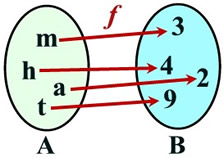 Amended Function f: Amended Function f:
BOTH
One-to-one and Onto
Each element of B is used only once, and ALL elements of B are used. |

NOTE: The re-posting of materials (in part or whole) from this site to the Internet
is copyright violation
and is not considered "fair use" for educators. Please read the "Terms of Use". |
|