|
In Algebra 1, you worked with Sequences in the unit on Functions. Mathematically speaking, you can think of a sequence as a function whose domain is the set of positive integers.
While sequences can be expressed using functional notation, they are most commonly written using subscript notation (as will be used throughout this unit).
 NOTE: functional notation will be mentioned briefly for A2 courses using both forms of notation. NOTE: functional notation will be mentioned briefly for A2 courses using both forms of notation.

 |
A sequence is an ordered list. It is a function whose domain is the set of positive integers {1, 2, 3, 4, ...}. |
|
Sequence: |
1, |
5, |
9, |
13, |
17, |
21, |
... |
Subscript notation for sequence terms |
a1 |
a2 |
a3 |
a4 |
a5 |
a6 |
|
The three dots (...), called an ellipsis, at the end of the sequence, means that the sequence goes on forever (to infinity).
 Information about sequences: Information about sequences:
| • |
A sequence may also be referred to as a "progression". |
• |
Each number in a sequence is called a term, an element or a member. |
• |
Terms of a sequence can be listed in set notation (curly braces): {1, 5, 9, 13, 17, 21, ...} |
• |
Terms are referenced in a subscripted form (indexed), where the positive integer subscripts {1, 2, 3, ...}, refer to the location (position) of the term in the sequence. The first term is denoted a1, the second term a2, and so on. The nth term is an.
|
• |
The terms in a sequence may, or may not, have a pattern or related formula.
Example: {1, 5, 9, 13, 17, 21, ...} can be generated by the formula an= 4n - 3.
Example: the digits of π form a sequence, but do not have a pattern.
|
• |
Terms of a sequence are listed in a specific order. |
• |
A subscripted form of a sequence is represented by a1, a2, a3, ... an, ...
Note: a1 may be simply referred to as a. |
• |
A functional form of a sequence is represented by f (1), f (2), f (3), ..., f (n),... |
• |
Sequences are functions. |
• |
The domain of a sequence consists of positive integers, 1, 2, 3, 4, ... |
• |
The range of a sequence consists of the terms of the sequence. |
• |
When graphed, a sequence is a series of dots. (Do not connect the dots). |
• |
The sum of the terms of a sequence is called a series.
|
Four ways of expressing (defining) sequences:
(Table or Chart):
Term Location
|
Term |
Subscript Notation |
Function Notation |
1 |
1 |
a1 |
f (1) |
2 |
5 |
a2 |
f (2) |
3 |
9 |
a3 |
f (3) |
4 |
13 |
a4 |
f (4) |
5 |
17 |
a5 |
f (5) |
6 |
21 |
a6 |
f (6) |
n |
|
an |
f (n) |
|
{1, 5, 9, 13, 17, 21, ...} (List)
Subscripted notation:
an= 4n - 3 (Explicit formula)
a1 = 1; an= an-1 + 4 (Recursive formula)
Functional notation:
f (n) = 4n - 3 (Explicit form)
f (1) = 1; f (n) = f (n - 1) + 4 (Recursive form)
Note: Not all functions can be defined by an explicit and/or recursive formula.
|
• |
A sequence may appear in a table or chart.
Example: shown above
The columns in the chart indicate the components. |
• |
A sequence may appear as a list (finite or infinite):
Example: {1, 5, 9, 13, 17} finite
Example: {1, 5, 9, 13, 17, 21, ...} infinite
Listing makes it easy to see any pattern in the sequence. It will be the only option should the sequence have no pattern. |
• |
A sequence may appear as an explicit formula. An explicit formula designates the nth term of the sequence, an , as an expression of n (where n = the term's location).
Example: {1, 5, 9, 13, 17, 21, ...} can be written in explicit form as a formula in terms
of n, an = 4n - 3. |
• |
A sequence may appear as a recursive formula. A recursive formula designates the starting term, a1, and the nth term of the sequence, an , as an expression containing the previous term (the term before it), an-1.
It can be written as a two-part formula in terms of the preceding term.
Example: {1, 5, 9, 13, 17, 21, ...} can be written a1 = 1; an= an-1 + 4.
|
Graphing Sequences:
Sequence: {1, 5, 9, 13, 17, 21, 25, 29, ...}
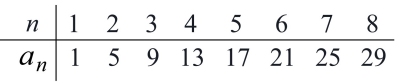
• Sequences are functions. They pass the vertical line test for functions.
• The domain consists of positive integers, {1,2,3,...}
• The range consists of the terms of the sequence.
|
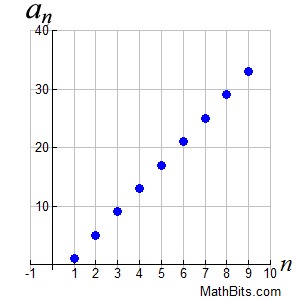 |
• The graph will be in the first quadrant and/or the fourth quadrant (if sequence terms are negative).
• The graph will be a discrete graph (a series of dots) as you are graphing only specific points.
Do not connect the dots.
|
Forms of sequences:
• |
A finite sequence contains a finite number of terms (a limited number of terms) which can be counted.
Example: {1, 5, 9, 13, 17} (it starts and it stops)
Example: {5, 4, 3, 2, 1} (listing in descending order is possible)
Example: {m, a, n, d, y} (letters are possible: sequence of letters in name "Mandy") |
• |
An infinite sequence contains an infinite number of terms (terms continue without end) which cannot be counted.
Example: {1, 5, 9, 13, 17, 21, ...} (it starts but it does not stop, as indicated by the ellipsis ... )
Example: {15, 30, 45, 60, ...} (starting with any value is possible)
Example: {1, 2, 1, 2, 1, 2, ...} (a pattern of alternating order is possible)
Example: {a, b, c, a, b, c, ...} (letters are possible) |
Special "Named" Sequences:
There are several types of sequences (or even individual sequences) that are referred to by name. Some of the more popular sequences are listed below:
• Arithmetic Sequences (such as {1, 5, 9, 13, 17, ...}
• Geometric Sequences (such as {2, 4, 8, 16, 32, ...}
• Quadratic Sequences (such as {4, 7, 12, 19, 28, ...}
• Harmonic Sequences (such as {-1, -1/2, -1/3, -1/4, ,,,}
• Triangular Number Sequence {1, 3, 6, 10, 15, 21, 28, ...}
• Fibonacci Sequence {0, 1, 1, 2, 3, 5, 8, 13 ,..}. |
In Algebra 2, we will be concentrating on Arithmetic Sequences,
Geometric Sequences, and the Fibonacci Sequence.
The Most Well Known Sequence Patterns:
You should always be on the lookout for possible patterns in sequences. Keep in mind, however, that while all sequences have an order, they may not necessarily have a pattern.
Two of the most popular patterns (that were seen in Algebra 1):
• |
Arithmetic Sequence: where you add (or subtract) the same value to get from one term to the next. The number added to each term is constant (always the same) and is called the common difference, d. The scatter plot of this sequence will be a linear function. |
|
|
• |
Geometric Sequence: where you multiply (or divide) the same value to get from one term to the next. The number multiplied is constant (always the same) and is called the common ratio, r. The scatter plot of this sequence will be an exponential function. |
|
|
Doubting Thomas wonders how we can know, for sure, that a sequence such as 2, 4, 6, 8, ... is an arithmetic sequence. His theory is that there could be many other possible patterns, such as: 2, 4, 6, 8, 2, 4, 6, 8, ... (repeating 4 terms is his pattern).
Yes, Thomas is correct. Without a specification in the problem, there is the possibility of more than one pattern in most sequences. The person creating the sequence may have been thinking of a different pattern than what you see when you look at the sequence. In Algebra 2, if in doubt, first look for arithmetic or geometric possibilities. |
|
Index (subscript) FYI:
The indexing (subscripts) used for sequences can technically begin with 0 or any positive integer. The most popular indexing, however, begins with 1 so the index can also represent the position of the term in the sequence. In Algebra 2, assume that all sequences begin with an index of 1.
FYI: Computer programming languages such as C, C++ and Java, refer to the starting position in an array (a sequence) with an index (subscript) of zero. Programmers must remember that a subscript of 3 refers to the 4th element, not the 3rd element, in the array. It is easy to see how this can be confusing for beginning programmers.

NOTE: The re-posting of materials (in part or whole) from this site to the Internet
is copyright violation
and is not considered "fair use" for educators. Please read the "Terms of Use". |
|