|
We worked with "domain and range" in Algebra 1.
Let's refresh those skills and add a few more details.
Under Defining Functions, we saw the difference between a relation and a function.
In either case, we are dealing with relationships that may be expressed as ordered pairs.
Both "relations" and "functions" have domains and ranges.
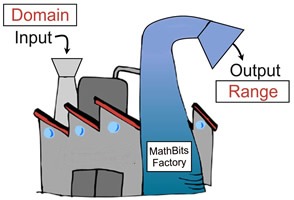 |
All of the values that can go into a relation or function (input) are called the domain.
All of the values that come out of a relation or function (output) are called the range.
Range may also be referred to as "image". |
The domain is the set of all first elements of ordered pairs (x-coordinates).
The range is the set of all second elements of ordered pairs (y-coordinates).
Only the elements "used" by the relation or function constitute the range.
 |
Domain: all x-values that are to be used (independent values).
Range: all y-values that are used (dependent values). |
|
For an equation in variables x and y, if the value of y depends on the value of x,
then y is the dependent variable and x is the independent variable.
The input variable (x) is independent, while the output variable (y) is dependent.

First, let's review what we know about domains and ranges from Algebra 1.
 Working with a set. Working with a set.
State the domain and range of the following relation: {(1,3), (-2,7), (3,-3), (4,5), (1,-3)}.
State whether the relation is a function.
Solution: Domain: {-2, 1, 3, 4}. Range: {-3, 3, 5, 7}.
While these listings appear in ascending order, ordering is not required. Do not, however, duplicate an element.
No, this relation is not a function. The x-value of "1" had two corresponding y-values (3 and -3).
 Working with a Venn diagram. Working with a Venn diagram.
State the domain and range for the elements matched in the diagram below.
State whether the matches form a function.
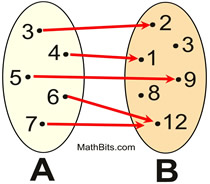 |
Solution: Domain: {3, 4, 5, 6, 7}. Range: {1, 2, 9, 12}.
Note that the range is only the elements that were used.
Yes, the relation {(3,2), (4,1), (5,9), (6,12), (7,12)}is a function.
No x-value repeats.
FYI: Set B = {1, 2, 3, 8, 9, 12} may be called the co-domain. It is the "possible" set from which output from the relation will fall. The co-domain is NOT necessarily the same as the range. There may be values in the co-domain that are never used. The co-domain is what "may possibly" come out to make a function, as opposed to what "actually" comes out to create the function (the range).. |
 Working with a discrete graph. Working with a discrete graph.
State the domain and range associated with the scatter plot shown below.
State whether this scatter plot is a function.
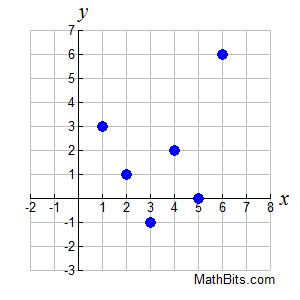 |
Solution: Domain: {1, 2, 3, 4, 5, 6}.
(Be careful not to simply list the domain as 1 < x < 6, which would imply ALL values between 1 and 6 inclusive, unless you specify "x is an integer".)
Range: { 0, -1, 1, 2, 3, 6}
Yes, this is a function. No x-values repeat, and it passes the Vertical Line Test for functions.
Note: Graphs that are composed of a series of dots, instead of a connected curve, are referred to as discrete graphs. A discrete domain is the set of only the x-values (usually integers) that appear in the given domain interval (or graph). |
|
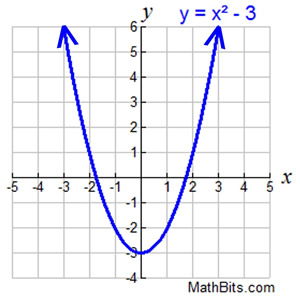
 Working with a continuous graph, represented algebraically ( y = x2 - 3 ). Working with a continuous graph, represented algebraically ( y = x2 - 3 ).
State the domain and range associated with the graph of y = x2 - 3.
State whether this relation is a function.
 Working with a discontinuous graph, represented algebraically ( Working with a discontinuous graph, represented algebraically ( ). ).
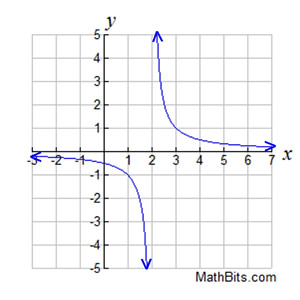
State the domain and range associated with the graph below.
State whether this relation is a function.
 The graph is . The graph is . |
This graph passes the Vertical Line Test and is a "function".
But it is NOT a function over the domain of all Real numbers. There is an algebraic error.
This graph is undefined when x = 2, because substituting two into the function will create a zero denominator.
If we restrict the domain to be "all Real numbers excluding 2", we have a function over this adjusted domain.
Solution: Domain of the function: 
Note: In Algebra 2, when working with algebraically defined graphs, it is common to see situations where certain values in a domain must be removed to prevent an error from occurring in the expression (for either relations or functions).
|
|
 When a graph is defined by an algebraic expression, the domain must assure that all values used can satisfy the expression, without creating an error. When a graph is defined by an algebraic expression, the domain must assure that all values used can satisfy the expression, without creating an error. |
 |
In Algebra 2, the emphasis regarding domain and range will be placed on analyzing advanced functions types, such as absolute value, exponential, logarithmic, piece-wise defined, rational, and radical functions.
|
See "Restricting Domains" for more information on these graphs. |

NOTE: The re-posting of materials (in part or whole) from this site to the Internet
is copyright violation
and is not considered "fair use" for educators. Please read the "Terms of Use". |
|


 means "is an element of"
 (all real numbers). x
  or [-3,∞) .